
With PM2.5 pollution under increased public scrutiny, sugarcane farmers, often blamed as major polluters, have been under growing pressure to stop burning cane fields. Many growers have complied with new government measures, contributing to a marked reduction in open-field burning. In the process, however, they have had to deal with higher costs, increased operational risks, labour shortages, and limited governmental support.
Although sugar mills pay higher prices for fresh cane, farmers say controlled burning, which turns fresh cane into lower-valued burnt cane, significantly reduces overall production costs, harvest time, and labour needs - particularly important under the tight harvesting schedules imposed by mills. Mills do not remove leaves on farmers’ behalf and the price of leaf-removal machinery remains beyond the reach of most growers. In contrast to comparatively-well mechanised counterparts in Brazil and Australia, global leaders in cane production, most Thai growers work small plots and have few options besides the use of manual labour.
A single rai of sugarcane yields around 10–15 tonnes of harvested cane and 1.5–2.5 tonnes of leaf waste. The waste is highly flammable, and to reduce the risk of accidental fires that could damage regrowth crops later, some farmers burn it early.
To curtail the practice, the government has thus far focused largely on restricting the purchase of burnt cane. Subsidies for fresh cane producers are also available, but these come with strict conditions and delays in disbursement (see the first instalment of this report - ‘Sugarcane farmers and PM 2.5 pollution: Is it really their fault?’. While such policies are beneficial, they stop short of addressing how farmers should manage large quantities of highly flammable cane waste in a sustainable way.
In 2024, the government sought to ease the problem by encouraging farmers to sell sugarcane leaves to mills for biomass electricity production, setting purchase prices at 750–1,000 baht per tonne. According to farmers, however, the policy has been unevenly implemented, as not all mills are willing to buy cane leaves.
Before cane leaves can be sold, they must be collected from fields, compressed into bales, and transported to mills. Each step—gathering, baling, and transport—increase costs, which are deducted from final payments. As a result, growers rarely receive the full advertised price, weakening incentives to participate.
Because of this, further reductions in pollution from cane field burning require more effective systems for managing large volumes of cane waste. While new technologies and management models are currently being developed, most farmers feel that sugar mills and the government should play a more active role in creating a more viable market for agricultural waste.
New solutions
Modern sugarcane production utilises more mechanisation than other major cash crops. Under pressure to transition to fresh cane, small-scale farmers have turned to leaf strippers, a tool developed to support fresh-cane harvesting, and high speed rollers that can be attached to tractors. Although priced in the tens of thousands of baht, these machines are growing in popularity because they can be used on small plots and require comparatively low investment.
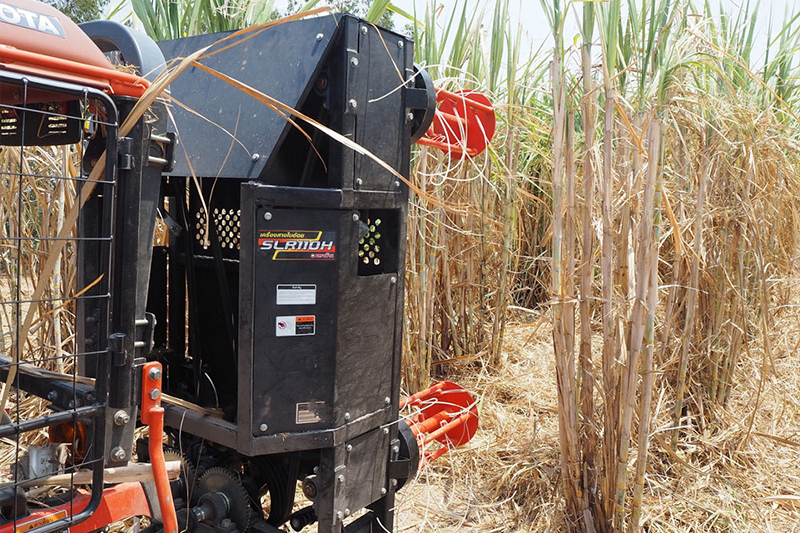
[Leaf strippers. Source: Mitrphol Modern Farm]
In comparison, large-scale harvesters cost up to 13 million baht, and with interest included, the price can reach 15 million baht. The repayment period is six years, averaging 2 million baht per year, while the machine is only used for roughly four months. These harvesters are therefore suited primarily to large-scale farmers with 1,000 rai or more and production levels of 10,000–20,000 tons.
To make leaf waste usable, it must be compressed into bales, similar to how rice straw is treated. Because of this, baling machines have become another essential tool. Existing models are large machines that produce big bales, in cylindrical or rectangular shape. They are of limited utility. Many farmers report that they only work properly when leaves have been stripped by large mechanical harvesters. Otherwise, the leaves are often too long and easily jam the machinery.
Even when leaves are packed into bales, only some factories buy them and those that do only pay around 800–1,000 baht per bale, depending on the company, region, and leaf quality. As bales are large and transportation costs are high, especially for farmers located far from factories, the extra income is not always as high as it could be.
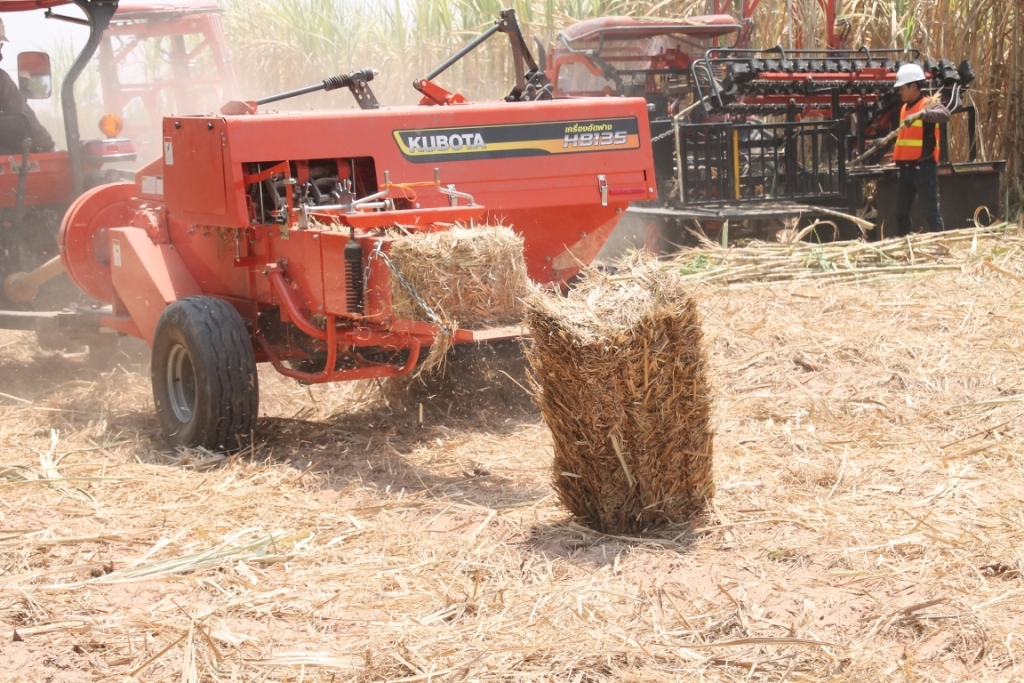
The old balers and large-sized bales. Source: Siam Kubota
To solve such problems, the Department of Agricultural Engineering at Khon Kaen University has invented a new baling machine that does not require finely cut leaves from large mechanical harvesters. The machine is also smaller and suitable for fields of all sizes. Furthermore, it can compress sugarcane leaves into one-inch bales, making them easier to transport and use at factories without being chopped up.
“Standard leaf bales used to sell for around 750–1,000 baht, but if they are compressed into a tiny rectangular bales, factories will pay at least 1,500 baht. They want them and can use them right away,” said Assoc. Prof. Dr. Kittipong Lalun, an expert in post-harvest technology and lead researcher on the mini-baler.
According to Dr Kittipong, the research is now at a stage where the machine can be practically deployed. All that remains is to scale it up for industrial use. Some factories have already shown interest and the team plans to trial-deploy their machine in real fields during the upcoming season.

[A new baling machine and smaller-sized bales, an innovation by the Department of Agricultural Engineering at Khon Kaen University]
Assoc Prof Dr Khwantri Saengprachatanarug a lecturer in the Faculty of Engineering, Khon Kean University, is looking at the application of drones in sugarcane fields. Data collected by drones can be used to combine clusters of small adjacent plots into virtual mega-farms which can be managing like a large consolidated field.
Drone observation can identify problems such as water shortages or weed infestations in each sugarcane plot. It can also estimate plot yield and sugar content, making collective planning among farmers possible. “We can actually coordinate with individual farmers to plant at the same time and later, a big harvester can come in and run through the plots in one go,” Assoc Prof Dr Khwantri said.
Under joint management, farmers can share equipment owned by one member of the group, rotating it as needed. The innovation is still being tested on factory-owned fields participating in the trial but an online platform is ready to use, with data accessible through a website for farmers and factories owners.
Promoting the consolidation of small plots requires that mills engage farmers directly to promote shared understandings and build cooperation. According to Assoc Prof Dr Khwantri, some mills have begun moving in this direction to support long-term sustainability for cane farmers. The development is welcomed, but stakeholders feel that more should be done.

Data from drone observation. Source: Assoc Prof Dr Khwantri Saengprachatanarug
“As for something the mills could do, why not harvest cane and collect the leaves in a single go, without stripping leaves off? India already does this because cane residue goes to the mills anyway. As for the leaves, they already have people who sell them to power plants … Mills should be able to manage this because they have more capital,” noted Danuphon Sontang, a sugar cane farmer in Khon Kaen.
This might pose problems for millers. By taking all the leaves, the responsibility calculating weight and potential loss would fall on the mills. However, Chaiwat Khamkaenkhun, president of the Nam Phong Sugarcane Farmers’ Association in Khon Kaen agrees that mills should support small-scale farmers who generally lack access to machinery that mills already have. He thinks they should also provide farmers with training to prepare fields so machinery can operate there.
There is presently little incentive for sugar mills to improve operations as they don’t really compete to purchase cane from farmers. Still, growers have begun calling on mills to demonstrate a spirit of reciprocity. Among other thing they argue that mills could establish zoning systems to group plots owned by smallholders together and provide harvesting services at fair rates.
More help required
According to industry experts, biomass power plants remain the primary buyers of cane field waste. Many feel that the state should develop other purchasing channels. “There must be a better solution because if the technology is introduced but farmers have nowhere to sell, it becomes meaningless,” said Assoc Prof Dr Kittipong.
Beyond fueling power plants, sugarcane leaves contain high carbon content and could be developed into products like biochar for soil improvement, biomass industry feedstock, bioplastics, or charcoal used in barbecue restaurants.
Assoc Prof Dr Khwantri said the government could encourage businesses of all sizes to use sugarcane leaves in their products by offering tax incentives, coupons, or other benefits. Such measures could be implemented through the Ministry of Digital Economy’s existing policies or via the Ministry of Industry.
“This isn’t about increasing or interfering with cane prices directly. It’s not market intervention. It’s about promoting all industries in Thailand that use bioplastics or sugarcane leaf–based products,” said Assoc Prof Dr Khwantri
Association president Chaiwat said that the state should also play a role in supporting educational institutions researching agricultural technology, so that more affordable machinery can be developed and distributed to sugarcane farmers.
Ultimately, stopping sugarcane burning will depend less on enforcement and more on whether farmers are given workable alternatives. Only when mills take a more active role, viable markets for cane leaves are secured, and state support makes non-burning economically rational, will open-field burning decline in a sustainable way.

Prachatai English is an independent, non-profit news outlet committed to covering underreported issues in Thailand, especially about democratization and human rights, despite pressure from the authorities. Your support will ensure that we stay a professional media source and be able to meet the challenges and deliver in-depth reporting.
• Simple steps to support Prachatai English
1. Bank donation via the "Foundation for Community Educational Media (FCEM)", Krungthai Bank, account number 091-010-4328, Swift Code: KRTHTHBK
2. Or, Transfer money via Paypal, to e-mail address: [email protected], please leave a comment on the transaction as “For Prachatai English”