
While Chiang Mai's 2024 PM2.5 crisis remains among the world's worst during the “haze season”, both the authorities and civil society are making some progress in addressing the issue.
From March to April 2024, PM2.5 pollution was severe in Chiang Mai, initially ranked by IQAir as the worst in the world in early March, then third worst 10 days later, fourth by early May, and later fifth. The situation only began to improve after several consecutive days of rainfall in May.
The situation looks grim, but the city of 1.2 million is not without hope. According to PM2.5 AQI Thailand, the number of days in 2024 with PM2.5 levels exceeding the standard was recorded at 80 at the 36T station at Yupparaj Wittayalai School, fewer than the 101 days in 2023 but still higher than the 43 days in 2022.
Learning from past challenges, the authorities and civil society have been refining their approaches, showing some progress in tackling the crisis.
Government Response
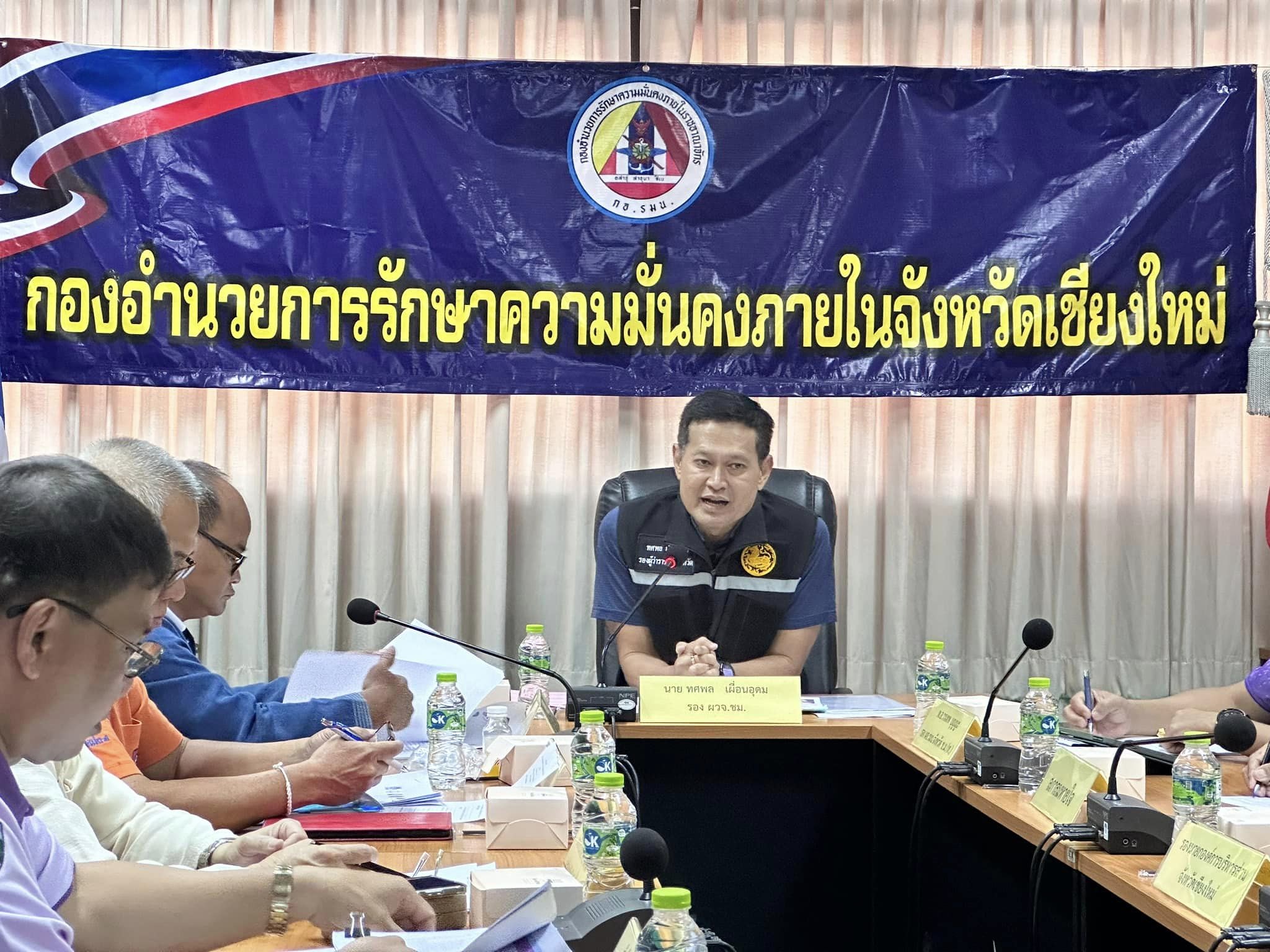
Thossapol Phuanudom, Deputy Governor of Chiang Mai (File photo)
When PM2.5 levels spiked in March, former Prime Minister Srettha Thavisin visited Chiang Mai to oversee the response to wildfires. Two million masks were distributed. He explained that he had not declared Chiang Mai an emergency area because existing resources were sufficient, and doing so would nullify insurance coverage for foreign tourists—a decision that drew public criticism.
While the government could clearly do more, some preparations had been made beforehand. In December 2023, Thossapol Phuanudom, Deputy Governor of Chiang Mai, mentioned in an interview that they had been "drawing lessons" from the challenges faced in 2023 to formulate a response plan for 2024.
In 2023, there were around 13,000 hotspots, 1,760 square kilometres of burned areas, 101 days of air quality exceeding safety standards, and 35,000 cases of respiratory illness. Since the end of 2023, the provincial administration of Chiang Mai had set the ambitious goal to reduce these key statistics by half.
To reach this target, the government reorganized the administrative divisions into seven forest areas, instead of sub-districts and districts, to prevent duplication. New work groups were established to plan strategies, consisting of leaders or advisors from the government, civil society, and the media. The resulting plans were passed on to local communities for feedback and refinement.
The Chiang Mai administration also collaborated with academics to utilize research and analysis, developing technologies for real-time communication and precise responses. The Ministry of Public Health and Chiang Mai University (CMU) were responsible for working with the private sector in setting up pollutant-free rooms, improving applications, and promoting them to coffee shops and shopping malls.
Additionally, there was a focus on monitoring the prices of face masks and air purifiers to prevent price gouging during the crisis. The FireD application was used to assess risks before burning activities. If the burning was not severe, it could proceed but had to follow scientific principles, such as creating firebreaks.
While the government didn’t quite reach the goal, the measures have led to some improvement.
"I want everyone to become aware and understand this issue more, with changes in attitudes and behaviour," said Thossapol, highlighting the importance of cooperation from all parties. "Everyone has a role to play. Urban residents need to understand hill people, and hill people also need to understand urban residents."
Regional Innovations

Wan Wiriya, Assistant Head of the Environmental Science Research Centre, Faculty of Science, Chiang Mai University
CMU has been pivotal in the technological battle against PM2.5 pollutants, aiming to reduce fatalities and respiratory problems.
Wildfires frequently occur in Chiang Mai, especially during the dry season, significantly contributing to PM2.5 pollution. Each year, villagers and volunteers are mobilized to combat these wildfires. However, the masks previously distributed have not provided adequate protection, leading to inhalation injuries, burns, and, tragically, deaths.
In response, Wan Wiriya, Assistant Head of the Environmental Science Research Centre at CMU's Faculty of Science, developed Masqura X—a positive pressure mask with a filtration system that removes 95-99% of PM2.5 particles. This year, these new masks have been distributed to 60 wildfire volunteers and Forest Department officers in Sri Lanna National Park.
Additionally, CMU has partnered with the Faculty of Engineering to create pollutant-free rooms for vulnerable groups, including individuals with respiratory diseases, children, the elderly, and pregnant women. These rooms are built at affordable prices for hospitals, schools, and nurseries, with support from private companies.
Training sessions on creating these pollutant-free rooms have also been organized for government agencies, helping them estimate costs. It remains their decision whether to proceed, but CMU stands ready to assist with air purifiers and filters, thanks to continued support from private companies.
Wan Wiriya also introduced a new project developing a self-cleaning filter using nanotechnology. This initiative, a collaboration between Chiang Mai University and King Mongkut's University of Technology North Bangkok, is currently in the experimental stage. While it may not completely eliminate PM2.5 pollution, these innovations are expected to make some impact.
Combating PM2.5 Pollution with Performance Art

Kitti Meechaikhett, drama teacher
Tackling PM2.5 pollution also requires raising public awareness, and one of the most impactful ways to achieve this is through theatrical performances.
Kitti Meechaikhett is an independent actor, drama teacher, and the founder of Base Performing Arts (BPA), a performing arts school in Chiang Mai, with 20 years of experience in the field. A decade ago, he left Chiang Mai due to health problems caused by the city’s air pollution and relocated to Bangkok.
Regretting that he hadn't done more to address the issue, Kitti began researching PM2.5 while in Bangkok. As the pollution crisis in Chiang Mai worsened last year, he felt it was time to take action. ‘The Plea of the PM2.5 City’, a documentary performance aimed at raising public awareness about the PM2.5 problem in Chiang Mai, was the culmination of his resolution.
Drawing from interviews, online articles, documentaries, and various sources of information, ‘The Plea of the PM2.5 City’ presented facts and diverse perspectives on the PM2.5 issue. Kitti said that after gathering and organizing the information, he was able to identify the key message he wanted to convey.
“Once we lined them up, we see who clashes with whom, and who we want to talk about,” said Kitti. “Drama has meaning, it is about emotions, which come from identifying opposing pairs. So, we position them as opposing pairs."
The audience did not just sit back and enjoy the performance; they also had the opportunity to read passages from real people collected by the team. This engagement made the play more interactive and helped them become more involved in the issue. The play was staged four times from 11-14 August 2023, and received a positive response from the audience, with attendees of various age groups.
Kitti believes that PM2.5 pollution from neighbouring countries has posed a new challenge in recent years and that it is already appropriate for Chiang Mai to focus on fuel management rather than a total prohibition on burning. He asserts that PM2.5 levels in Chiang Mai can still be reduced if the central government places more trust in local governance.
" Civil society in Chiang Mai is very strong,” said Kitti. “But even if Chiang Mai has managed well overall, I still want the central government to transfer power or allow us to manage some things on our own."
Fire Management Strategy
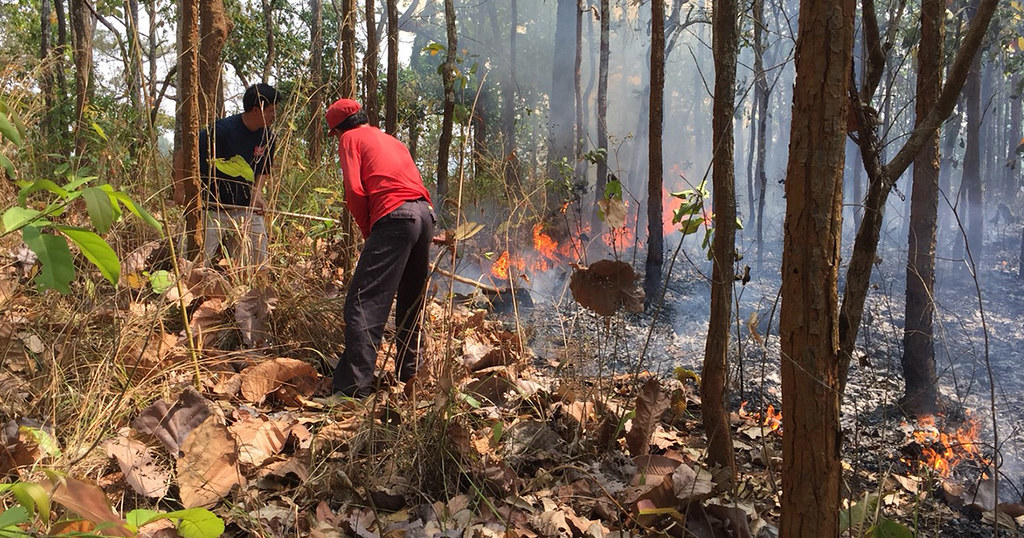
Making firebreaks in the forest surrounding Doi Suthep (File photo)
As Chiang Mai has struggled with PM2.5 pollution over the years, civil society has become increasingly active in addressing the issue. The Chiang Mai Breath Council, established in 2019 by organizations from the public health sector, private sector, and civil society, serves as a key mechanism for tackling air pollution in a more systematic and sustainable way.
Chatchawan Thongdeelert, Chair of the Chiang Mai Breath Council, said that strategies in the past 14 years based on the Disaster Prevention and Mitigation Act were largely reactive, addressing issues and mobilizing resources only after problems emerged. To address this shortcoming, the Council advocates a more proactive approach.
"But we believe that the solution to the problem of the PM2.5 pollution must be proactive problem-solving,” said Chatchawan. “There must be prevention plans, short-term, medium-term, and long-term plans, which would be a sustainable solution."
The Chiang Mai Breath Council's strategies include pushing forward the Clean Air Act, designed for a proactive response to PM2.5 pollution from multiple sources. The draft was approved by the Cabinet in November last year and passed the House of Representatives in January, alongside six other drafts from political parties within both the government coalition and the opposition. The Council advised the parliamentary committee as it worked to merge all seven drafts into a single act.
The council advocates a shift from top-down directives to the active involvement of communities and local administrative organizations in the planning process. This includes support for transitioning from a zero-burning strategy to fire management, recognizing the ecological role of fire in areas such as deciduous forests and its agricultural role in rotational farming. However, fire must still be strictly controlled to prevent it from spreading.
The idea of reorganizing administrative divisions into seven forest areas and establishing new work groups originated from the Council’s proposal, which called for a clearer process of local participation. To support this initiative, the government agreed to the proposal and covered the expenses related to formulating the response plan.
In the Doi Suthep area, which is close to the city and includes 12 Hmong villages across seven districts, efforts focus on prevention through the establishment of firebreaks. In other areas, such as Samoeng and Ban Pong, the emphasis is on fuel management and fire control. Additionally, the FireD application, developed by Chiang Mai University scholars, has been deployed to enhance wildfire management efficiency.
Beyond fire management, Chatchawan advocates improvements in the public health system, including the provision of masks, air purifiers, and free lung check-ups. “We still want to see a good health insurance system. There must be welfare for self-protection and agreements with neighbouring countries. If we can do all of these, I think the situation should improve.”
Rotational Farming and Fire Control
Despite widespread criticisms that rotational farming communities create PM2.5 pollution, the Pwo Karen in Ban Mae San, Ban Dong Subdistrict, Mae Mo District, Lampang Province, demonstrate that a well-organized, community-driven approach to fire management is possible. This could serve as a model for Chiang Mai.
The Karen in Ban Mae San have been practicing rotational farming for over 300 years. However, their way of life was severely disrupted by the zero-burning policy. Sustained advocacy from civil society eventually led government officials to acknowledge that exceptions to the policy could be made if there was a clear fuel management plan, though this option is often overlooked.
“Our village has done rotational farming since our ancestors’ times, which requires burning by fire. But we burn in a controlled way,” explained Kaew Lapma, the village head and a farmer in Ban Mae San.
Burning follows a strict schedule, starting in March and requiring prior permission from the village head. It is conducted between 3:00 PM and 5:00 PM, with each field taking about 30 minutes. This timing is crucial for their agriculture, as they rely on ashes from effective burning during the dry season, just before the first rain, to grow subsistence crops without the use of fertilizers.
“We don’t want anything much because we already have a simple way of life,” said Natthanon Lapma, a Karen villager at Ban Mae San.
In addition to controlled burning, the Ban Mae San community has implemented other fire control measures. “We help each other to create firebreaks and look after them until the fire is completely extinguished,” said Natthanon. These firebreaks are typically created around the fields. The community also actively patrols for wildfires, establishing 4-5 watch points from February to April with rotating shifts.
Apart from having the zero-burning policy revoked to sustain their livelihoods, the community needs more government support for food, drink, and equipment such as air blowers to enhance fire control efficiency. “Our area has a watershed 1-2 classification, which is considered fertile,” said Kaew. “If we don’t look after it, both the forest and wildlife will disappear.”

Prachatai English is an independent, non-profit news outlet committed to covering underreported issues in Thailand, especially about democratization and human rights, despite pressure from the authorities. Your support will ensure that we stay a professional media source and be able to meet the challenges and deliver in-depth reporting.
• Simple steps to support Prachatai English
1. Bank donation via the "Foundation for Community Educational Media (FCEM)", Krungthai Bank, account number 091-010-4328, Swift Code: KRTHTHBK
2. Or, Transfer money via Paypal, to e-mail address: [email protected], please leave a comment on the transaction as “For Prachatai English”