

By Prachatai |
A new wave of armed clashes between Thailand and Cambodia has escalated, casting doubt over the status of the peace agreement signed just two months ago. Thai Prime Minister Anutin Charnvirakul said that Thailand will no longer enter into negotiations unless Cambodia complies with the conditions set by Thailand.

By Prachatai |
Since taking office, Thailand’s Prime Minister Anutin Charnvirakul has adopted a hardline stance against Cambodia, culminating in the move to suspend the two-week old peace agreement over the latest landmine casualties. What is behind this move? And most importantly, how much influence does a powerful domestic driver like the military have in shaping the government’s decision?

By Ford (Tattep) Ruangprapaikitseree |
When the 19 September 2006 coup happened, Ford Ruangprapaijitseree was in elementary school, and at the time, the coup only meant that he got a day off from school. He writes now that the coup not only revealed how normalised military intervention had become but also set the stage for institutions deliberately designed to weaken civilian authority over the armed forces. Changing this design is now one of Thailand’s most urgent democratic tasks.

By Supalak Ganjanakhundee |
The recurring clashes between Thailand and Cambodia are often described as the residue of colonial-era boundary disputes. This explanation, however, obscures the real dynamic: the Thai military’s repeated exploitation of anachronistic disputes to preserve its political dominance.

By Prachatai |
The Thai military has been intruding into civilian affairs, says US academic Dr Paul Chambers, who had returned to the US after being charged with royal defamation in April 2025. It is likely to become more autonomous under the new government, led by Anutin Charnvirakul.

By Prachatai |
Even though there have not been further clashes since the 28 May clash at Chong Bok, the border dispute between Thailand and Cambodia appears to be escalating. Amid growing uncertainty, the Pheu Thai government faces public outcry, fuelled by surging nationalism, talk of legal efforts to replace the Prime Minister, and even calls for a junta, while civil society continues to campaign for peace. Meanwhile, the Royal Thai Army arbitrarily announced its readiness to use force.
Supalak Ganjanakhundee, a former news editor, a researcher and an advisor to the House of Representatives' Committee on the Armed Forces, said the Thai military said the Thai military has taken on many responsibilities that should fall under the civilian government.

By Prachatai |
The Internal Security Operations Command (ISOC) has asked that the sale of a new research monograph on the behind-the-scenes role of the Thai military in Thai politics be suspended, claiming the study is based on misinformation and damages ISOC’s public image.

By Kittiya On-in |
By Yiamyut Sutthichaya |
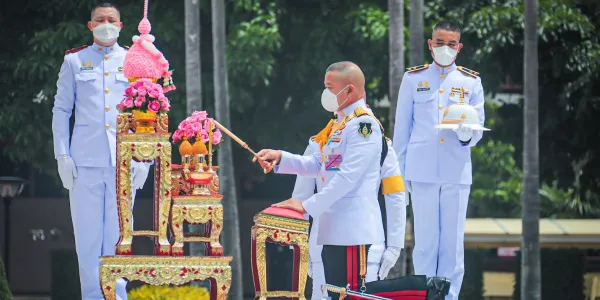
<p>Academic Supalak Ganjanakhundee explains that in the recent 2022 military shake-up, the ‘red rim’ soldiers who are symbolically close to the king have taken over many key positions, reflecting a core problem at the root of the Thai democratic transition that has been plagued by military coups.</p>
By Yiamyut Sutthichaya |
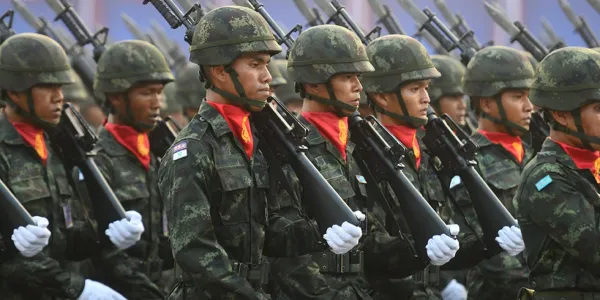
<p>A talk with Thep Boontanondha, author of “The King’s Soldiers and the Fostering of Faith and Loyalty” in an attempt to see how the Thai armed forces have been imbued with monarchism. As the influence of the monarchy ebbs and flows, the practice lives on, affecting the political landscape even after the fall of the absolute monarchy.</p>
<p>An international think tank monitoring corruption has revealed in its latest report that Thailand’s defence spending is among the least transparent in the world, especially since the 2014 coup d’état.</p>
<p>According to the 2015 <a href="http://government.defenceindex.org/countries/thailand/">Government Defence Anti-Corruption Index (GI)</a> compiled by Transparency International, Thailand’s defence spending is graded ‘E’ in an index with grades ranging from ‘A’ for best practice to ‘F’ for the worst. </p>
By John Draper |
<p dir="ltr"><span id="docs-internal-guid-c69fad9d-1134-73ce-a725-04eebe6040c0">The International Civil Aviation Organization (ICAO) on Thursday 18</span>th June "red flagged" Thailand over major safety concerns within the country's aviation system due to its failure to reform the sector within 90 days, following an earlier warning in March. The ICAO is a United Nations agency tasked with overseeing the world’s management of air safety, air navigation capacity and efficiency, security, the economic development of air transport, and environmental protection.</p>