
By Kornkritch Somjittranukit |
<div>
<div>
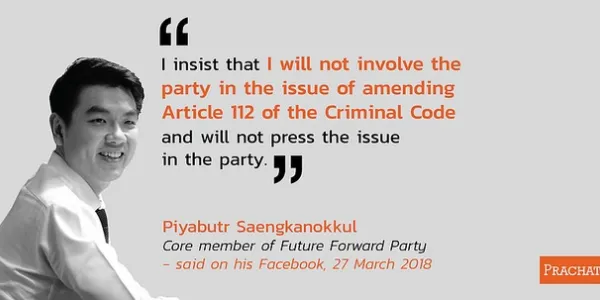
<div>The recent announcement by a key leader of the Future Forward Party (FFP) that he would not press the issue of amending the l?se majest? law in the new party, has sparked a political debate on whether the politician is making a strategic move or retreating from his liberal stance.</div>
<div> </div>
<div>The newly-established FFP has continued to incite controversy after Piyabutr Saengkanokkul, one of the party’s most prominent members, announced on Facebook that he would not use the new party as a political tool to amend Article 112 of the Criminal Code, the l?se majest? law
</div></div></div>
By Kornkritch Somjittranukit |
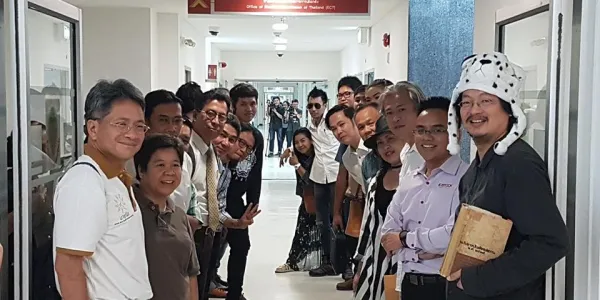
<div>A prominent anti-junta activist has formed a new political party, vowing that the party will ‘’not look for votes, but for problems’’, propose superior policies, and bring entertainment to Thai politics. The members include an environmentalist, a dog-lover, a historian geek and a software expert.</div>
<div> </div>
<div>In early March, Sombat Boonngamanong, a pro-democracy activist, announced that he was running a political party and was going to participate in the upcoming general election.
</div>
By Kornkritch Somjittranukit and Thaweeporn Kummetha |
<div>
<div>The newly established Future Forward Party (FFP) has been heavily criticised for its lack of political experience, and its left-leaning orientation, with lots of talk of a social welfare state and inclusive society. </div>
<div> </div>
<div>On 15 March 2018, Thanathorn Juangroongruangkit, Executive Vice President of the Thai Summit Group, hosted a press conference to launch a new party, Anakhot Mai, literally translated as ‘new future’, but whose official English name is the Future Forward Party. </div>
<div> </div>
</div>
<div> </div>
<div style="text-align: cente</p>
</div>
By Kornkritch Somjittranukit |
<div>Red shirts-turned-royalists, anti-election leaders, “moral politics” supporters, an ex-junta official and an anti-lèse majesté academic have all revealed their intention to participate in the upcoming election. And this is just the beginning.</div>
<div> </div>
<div>2 February was the first day of registration for new political parties, with over 40 registered at the Election Commission of Thailand (ECT). But will these new parties lead to new choices for the people?
</div>
By Yiamyut Sutthichaya and Thaweeporn Kummetha |
<div>
<div>
<div>On 5 January 2018, the Thai authorities detained Sam Sokha, a prominent labour activist, and deported her to Cambodia on 8 February. The incident has raised concerns among various human rights organisations that Hun Sen and the Thai military government are covertly making a deal on exchanging political refugees. </div>
<div> </div>
<div>The Thai and Cambodian government officials cooperated in arranging a hurried deportation of the activist. She was deported little more than a month after she was arrested.
</div></div></div>
<div>
<div>
<div>The Ministry of Energy and anti-coal protesters have reached an agreement to temporarily halt plans to build two power plants in Krabi and Songkhla.
</div></div></div>
By Kornkritch Somjittranukit |
<div>Since the junta leader coined the term “Thai-ism democracy,” various politicians have observed that it is just another attempt by the junta to justify its authoritarian politics by using beautiful words. But looking at Prayut’s further explanations, it might be worse than that.</div>
<div> </div>
<div>“Thailand can no longer be in conflict.
</div>
By Kornkritch Somjittranukit |
<div>
<div>A new organic bill appears to breach the constitution, by allowing the current National Anti-Corruption Commission (NACC) chair, who has a close connection with the junta, to continue in office despite being constitutionally ineligible. </div>
<div> </div>
<div>Over the past week, the Thai public has questioned the NACC over its ability to investigate corruption allegations surrounding the National Council for Peace and Order (NCPO), given that NACC Chair Pol Gen Watcharapol Prasarnratchakij has close ties with Gen Prawit Wongsuwan, the NCPO deputy chairperson. </div>
<p><di</p>
</di</p></p></div>
<div>
<div>Anon Nampa is a human rights lawyer and pro-democracy activist who is renowned for his sense of humour. Today the police accused him of contempt of court and violating the controversial Computer Crimes Act over his Facebook posts that criticised the prosecution of pro-democracy activists. </div>
<div> </div>
<div>If found guilty, Anon will face up to five years in jail for violating the Computer Crimes Act and up to seven years in jail for contempt of court.
</div></div>
<div>
<div>A vague anti-corruption bill and influence over the National Anti-Corruption Commission make up the latest in the junta’s efforts to ‘cleanse’ Thai politics. But with corruption scandals plaguing the NCPO itself, how pure are its intentions? </div>
<div> </div>
<div>The <a href="http://www.anticorruption.in.th/2016/th/index.php">Anti-Corruption Organisation of Thailand (ACT)</a>, a Thai elite network against corruption, has released a list of the ten most egregious corruption cases of 2017.
</div></div>
<div>Today (25 December) Artiwara Kongmalai or “Toon Bodyslam” is scheduled to finish his charity run from Yala to Chiang Rai to raise money for public hospitals. The run has exceeded its goal; it has received over 1,000 million baht. However, Thailand’s healthcare is a structural problem that needs a sustainable solution. Still, the charity run has raised a debate on healthcare funding in the face of an anticipated budget cut under the junta government. </div>
<div>
</div>
<div>
<div>This year, Prachatai recognises the People’s Health System Movement as its Person of the Year, for its relentless efforts to protect Thailand’s universal healthcare scheme from the junta’s threats.</div>
</div>
<h2>Who is the People’s Health System Movement (PHSM)?</h2>
<div>
<div>The PHSM emerged almost two decades ago under the leadership of Dr. Sanguan Nitayarumphong.
</div></div>