

By Prachatai |
In its 2026 annual report, Amnesty International raises concerns about ongoing human rights violations in Thailand, including the detention of political prisoners and the lack of protection for refugees.

By International Federation for Human Rights (FIDH) |
In an open letter to Thailand’s 32nd Prime Minister Anutin Charnvirakul, FIDH, UCL, iLaw, and TLHR highlight 10 key human rights priorities raised by United Nations (UN) human rights mechanism and call on Mr. Anutin and his administration to effectively address these unresolved issues without delay.

By Puttanee Kangkun |
On 11 December 2025, the Bhumjaithai Party, led by the now Caretaker Prime Minister Anutin Charnvirakul, dissolved parliament, with the aim of capitalizing on the nationalist sentiments stirred up by the armed conflict between Thailand and Cambodia, and the public admiration for the Half-Half Plus Co-Payment Program – a populist program that the government would subsidize half of, in total 2,000 THB per individual daily spent to buy goods. Consequently, intense nationalistic and economic rhetoric has dominated the election programs—combating online scam centers, illicit capital tied to transnational repression, and corruption have become the main emphasis for most parties. These are all genuine concerns, and it is right that they should be raised, but the human rights violations associated with them also need attention.

By Prachatai |
A Thai Criminal Court has convicted a former Thai marine who shot and killed Cambodian opposition politician Lim Kimya and sentenced him to life in prison. The assassination was seen as politically motivated and made clear that Thailand is no safe haven for political dissidents.

By Prachatai |
A Thammasat University student has been released after staging a solo protest against the attendance of Myanmar junta leader Senior General Min Aung Hlaing at the 6th BIMSTEC summit taking place in Bangkok. No charges were filed against him.

By Prachatai |
The Thai Civil Court has dismissed a case filed by Thai activist Jatupat Boonpattararaksa against the NSO Group, the Israeli manufacturer of the Pegasus spyware, saying the plaintiff had insufficient evidence to prove that the company had violated his privacy. Meanwhile, his lawyer pointed out the unequal footing between the plaintiff and the defendant.

By Engage Thailand |
Engage Thailand has officially launched with the mission to advance Thai democracy and human rights at the international level by educating the public, mobilizing the Thai diaspora, and building relationships with international organizations.

By Prachatai |
General counsel for the Israeli spyware firm NSO Group has testified in the Pegasus spyware case filed by a Thai activist for allegedly infringing privacy rights. This is the first time he has taken the stand as a defence witness to provide insight into how Pegasus functions. The verdict is scheduled for 21 November.

By Prachatai |
Renowned historian Thongchai Winichakul has pointed out that the Thai justice system operates under a “royalist rule of law”, which establishes a state of exception allowing the infringement of the people’s rights and freedoms under the pretext of national security.

By International Federation for Human Rights (FIDH) |
Four human rights organizations have published an open letter to Prime Minister Srettha Thavisin, highlighting 10 key human rights priorities remaining unaddressed under previous administrations, from space for civil society and accountability for extrajudicial killings, torture, and enforced disappearances to gender equality, and urged the new government to begin the implementation of their recommendations within the first 100 days in office.
By Amnesty International |
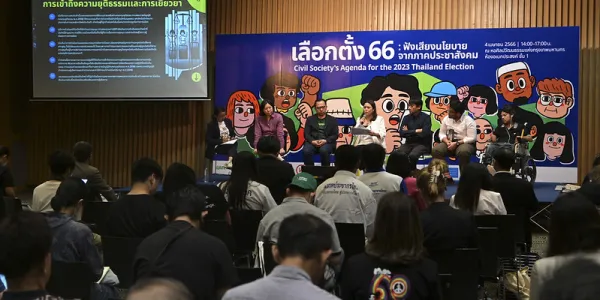
At today's (4 April) press conference, civil society organizations calls on political parties to recognise in their policies civil and political rights, and the rights of migrant workers, refugees, persons with disabilities, children, women, LGBTQi and ethnic groups in Thailand.
By Yiamyut Sutthichaya |
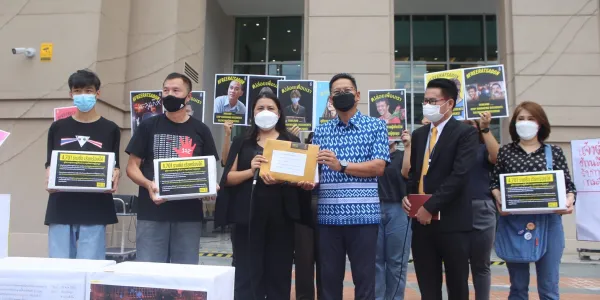
<p>The Thai office of Amnesty International over the past few months has increasingly turned to tackle more domestic human rights issues. An interview with the Country Director reveals that this decision has had a great impact, even threatening the organization’s existence, and including death threats against Amnesty personnel.</p>