
Sulaiman Naesa, 25, was found dead inside a military detention camp in Pattani on 30 May 2010, after he had been arrested and detained there for 9 days under the Emergency Decree. The military has claimed that he committed suicide by hanging himself with a towel from the window bars. His family’s suspicions, however, have never been proven, since according to Muslim belief an autopsy is forbidden.
His body was found to have many marks of bruising. The neck was broken, and traces of bleeding were found in the testicles and anus.
In response to these suspicions, panels have been formed by the National Human Rights Commission and the Internal Security Operations Command Region 4 to investigate the cause of his death.
Nevertheless, neither investigation has yielded any conclusive findings, as the family members did not allow an autopsy to be conducted.
According to Muslim belief, an autopsy is prohibited as it is considered to be torture of the body. And suicide is a grave sin.
Prachatai met his parents and his youngest brother, 5, at their home in Hutaemajae village, Kadunong Subdistrict, Sai Buri District, Pattani, together with other relatives and local religious leaders.
The story of Sulaiman’s death has been the talk of the village. The family’s hardship has grown ever more severe since the loss of a key member.
Sulaiman was the eldest son, with four siblings including an immediately younger sister who is studying religion at Sabuding Pondok at Kapho District in the same province. The third child is in Grade 9, and the fourth in Grade 3.
According to his father Jaewae, Sulaiman hardly studied at all. He was forced to go to a pondok for religious study, but returned home after nearly a month. The father took him back, but he came back again.
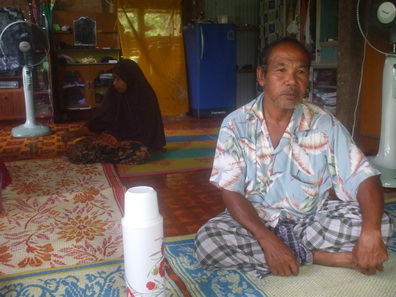
Sulaiman's father
When he had no work, he would sit alone on the bank of the Sai Buri River, not socializing like others.
Before his death, he was another breadwinner for his family, in addition to his father. He was a skilled iron welder in construction work. He also earned extra income through aquaculture, raising giant gourami in the Sai Buri River, about 500 meters from his house.
Last year, Sulaiman participated in state programmes including the Peaceful Community Development According to the Sufficiency Economy Project and the Development Project According to the Strategy of Resolving and Developing the Southern Border Provinces, receiving some domestic fowls and catfish to raise. He also went to state training sessions.
Now the catfish pond and henhouse built by Sulaiman in the backyard have been left unattended.
‘There are still some catfish, but they may be quite lean. I myself just had a look today,’ his father said, while showing Prachatai the plastic-sheeted pond and the seemingly unfinished henhouse.
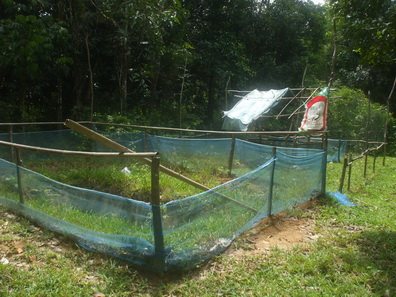
‘Most of the chickens have died. Only a few are left. We have let them stay under the house with our other chickens.’
Sulaiman’s family has received 10,000 baht as preliminary financial assistance from the military and a basket of gifts from the Region 4 Army Commander.
Maj Gen Montri Umari, who brought the money and the gifts, also proposed to sponsor the family members’ travel to Mecca in Saudi Arabia for the Hajj. But under such mournful circumstances, the father refused, saying that he had to take care of the other four children.
‘I still felt sorrowful. So I told [the general] that I didn’t want to go,’ the father, 59, said firmly, and so did his wife.
Although he had not yet been able to take up the proposal to travel to Mecca for the fifth most important duty of a Muslim, the local mosque in the village received money from the military brought by the general to repair the ceiling. And during the same visit, a female general of the Air Force also gave rice and canned food to the villagers.
Without Sulaiman, the father has to return to construction work as a skilled carpenter, but it is quite tough for him without the assistance of his son.
His mother taps the family’s one rai of rubber trees. And they can gather fruit from the trees around the house.
Up till now, the conversation was lively, with nipa palm leaf cigarettes, and the water in the kettle long cooled.
Another thing that disturbed them was that the security authorities had stated that Sulaiman was involved in 14 incidents of unrest.
‘That would involve every incident to happen in Sai Buri,’ one relative said.
Each of them then tried to recall what had happened.
When there were shootings during the selection of conscripts, Sulaiman was scraping coconut at home, his mother said.
When a group of men in black opened fire at military vessels on the Sai Buri River, Sulaiman had been hired to tap rubber trees in Yala’s Bannang Sata District for 20 days, one relative said.
The latest incident was the shooting of a woman in another village in the morning, which led to the arrest of Sulaiman at 10 am on the same day, while he was hired to thatch the roof of a neighbour’s house.
It was the arrest that led to his death 9 days later at the Inkayutthaborihan military camp.
‘Just present the proof of the cause of Sulaiman’s death, and why his body was full of bruises. Why can’t [the military] say it clearly? We just want this justice, to try to prevent others from dying like Sulaiman. We want him to be the last casualty,’ his father said.

Prachatai English is an independent, non-profit news outlet committed to covering underreported issues in Thailand, especially about democratization and human rights, despite pressure from the authorities. Your support will ensure that we stay a professional media source and be able to meet the challenges and deliver in-depth reporting.
• Simple steps to support Prachatai English
1. Bank donation via the "Foundation for Community Educational Media (FCEM)", Krungthai Bank, account number 091-010-4328, Swift Code: KRTHTHBK
2. Or, Transfer money via Paypal, to e-mail address: [email protected], please leave a comment on the transaction as “For Prachatai English”