
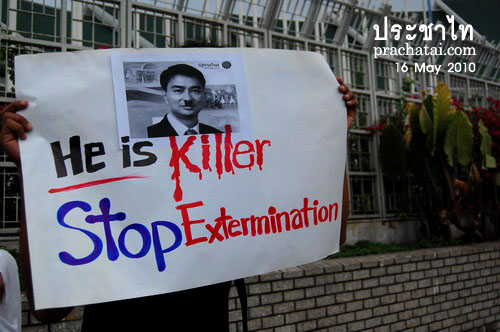
May 16, 2010, at the entrance of the United Nation’s conference centre in Bangkok, a group of students and labourers gathered there were shouting “Abhisit stop killing.”

It was late morning on May 16. Around 30 people gathered in front of the UN building on Ratchadamnoen Road. They’d gone there to submit an open letter asking for the UN to intevene against various instances of human rights violation. The letters, written in Thai and English, will be forwarded to the UN’s human rights officials.
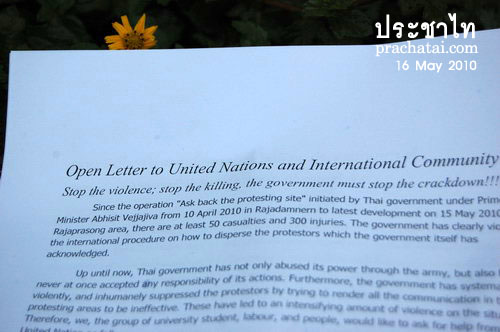

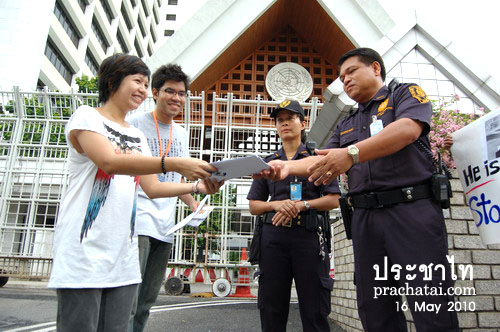
“The human rights officials already know we will be submitting the open letter to them. But we’ve decided to come in person today anyway because we feel it’s important to come out and demand an immediate end to the shooting.” Fai, a Chulalongkorn University student told Prachatai. She heard that another group of academics were planning to submit a similar letter, and had requested to meet the UN officials this coming Tuesday.
“We feel this may be too late. In two days’ time, who knows how many more people will be killed. If possible we would like the opportunity to meet with the officials directly. Maybe we will come back on Tuesday.” Fai added before moving off to hand out stickers, with “Stop Kill” written on them in Thai and English, to vehicles waiting at the red light at Makkhawan intersection. A voice in one of the cars shouted, “kill them all.” Meanwhile a taxi driver got out of his vehicle and asked the group excitedly what they were doing there. When they told him they’d come to request the UN’s intervention in the current operation against citizens, which constitutes a human rights violation, the taxi driver took several stickers to display on the back window of his car. He also asked for a few of the flags with “Stop Kill” written on them in Thai and English.
At this time of intense media censorship, and the deployment of violence against citizens, Prachatai tries to avoid photographing the faces of people we talk to. But this taxi driver permitted us to reveal his face and name. He had this to say during the conversation he started up with the group activists in front of the UN.
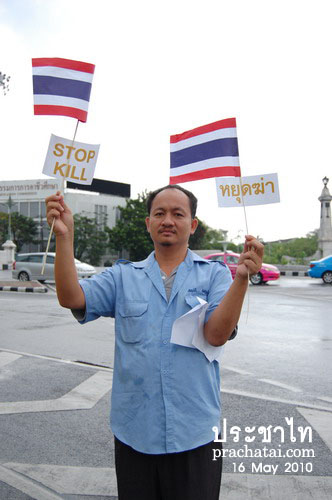
“I want the government to start being reasonable, to adopt a reasonable stance about what the other side wants. If the government wants the mob [a thai reference to demonstrations and protests in general - Prachatai] to stop demonstrating, it has to end the state of emergency, then start negotiating again. The government can’t force its own justification on the other side – the excuses are terrible anyway. This government’s just shooting, then saying it’s open to negotiation, then murdering and bringing in more soldiers. Is this what the government calls sincerity? For negotiation to take place you have to stop injuring and killing first. You can’t keep attacking the other side then say let’s negotiate. There’s no chance to do that properly. You have to end the state of emergency, withdraw the soldiers, and then get the red shirts back to negotiation. If the red shirts refuse, then they will lose legitimacy. You can’t tell the red shirts to stop but let the military continue killing. What about innocent people sitting inside listening to the red shirts’ speeches? Are the soldiers going to go kill them? These people are there because they want to hear the politicians speak. Holding different opinions isn’t a justification for murder. You can’t do that then accuse them of being terrorists. What do they call the rebels down south, then? Troublemakers? They call terrorists people carrying flags and walking around. They shoot them in the head, in the legs. It’s gone too far.”
We asked him what he would like to say to other social groups.
“I want the students to set up their own stage and speak to the people, make some national demands. Students have to make a stand, like the time of the Sujinda coup [in 1991-2]. Right now, innocent people are getting shot, or killed. I’ve been wondering what’s happened to the students and intellectuals? Why haven’t they come out? Students have to be neutral because they’re educated, they’re intellectuals. In the future it’s the students who’ll hold senior positions, become prime minister or ministers. If the intellectuals are doing nothing, then who can ordinary people rely on? People like me, uneducated, ignorant people. Those people who are being misled by politicians, no one’s helping them. No one’s educating them. If law students, or government and administration students, aren’t helping people, then people will be misled by politicians on both sides – both Puea Thai and Democrat politicians. There has to be a neutral group, someone who can educate people about government. But right now the students are doing nothing, they’re just letting both sides destroy each other. Educated people aren’t doing anything at all. I’m glad to see you folks here. Personally I’ve never gained anything from the mobs, and I’ve been to both mobs [yellow and red]. It’s all about their own interests. If the students come out, I’ll go with them.” He concluded before driving off in his taxi.

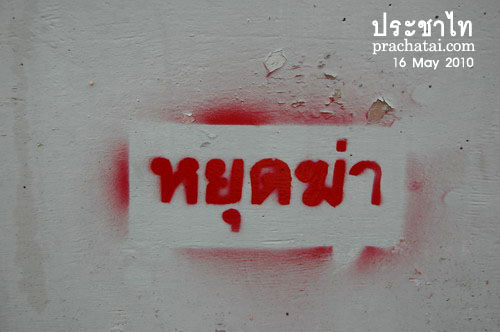


Prachatai then spoke to two students from the group Seri Panyachon [liberal intellectuals].
“I would like to see a proper application of law, and an end to the killing. The claim that soldiers only fire in stages, starting from rubber bullets, isn’t right. There’s still no justification for using live rounds. It’s a violation of people’s rights.” Gus, a 17 year-old freshman, said to us.
“Some areas have signs up saying “live bullet area,” what do they mean by that? We have to demand that the government stop killing citizens. After this, we’d like to see various groups join up to go put pressure on government institutions that are responsible for this situation, such as the Ministry of Defence.” Petch told us.
Pimsiri Petchnamrob, from the YPD group, said the group’s fundamental demand is, in the first instance, for the government to cease using force on demonstrators. In her view, aside from the fact that war weapons are being used against the demonstrators, the crackdown also generates other consequences which the government may not be able to control. It may lead to a situation in which no one is clear who they’re fighting against. The government itself might go too far.
“The government’s use of weapons in the crackdown doesn’t help the situation, it only makes things worse. Enthusiastically cheering on the crackdown, saying “kill them, kill them” doesn’t help either. What are people thinking of when they say, “kill them all”? Ratchaprasong is filled will children, elderly people, and women. I want people to stop to think before they say hateful things like that.”
As we were talking, Prachatai received a message from Thai Rath newspaper that the government was preparing to announce a curfew in certain areas. We asked Pimsiri whether she felt frightened taking part in this kind of campaign, even if the campaign was for a human rights cause.
“No, I’m not scared. We’re in front of the UN, I don’t think anything will happen to us.”
Chawathi Srikaew, or Terng, from the Son Right group, added, “I would like the UN to intervene because the government is abusing the law. It’s using force with no regard for legal principles. If many of us come out to make a stand against this, if our numbers are large enough, we may help the peace advocates achieve victory over those who resort to violence.”
Prachatai asked him the same question as we did the other students, “are you scared?”
“No, I’m not. I’ve been at the demonstration site. The past two nights I was there, before the violence broke out. I’ve been following events. The area was so quiet, like a ghost town. I heard rumours that sniper shooters were hiding on every building. I was at Saladaeng. What I would like to see is for the violence to end right now before things escalate further. Whoever abhors the use of force don’t be afraid, I’m here, we’re here. If many of us come out like this, they won’t dare do anything.”
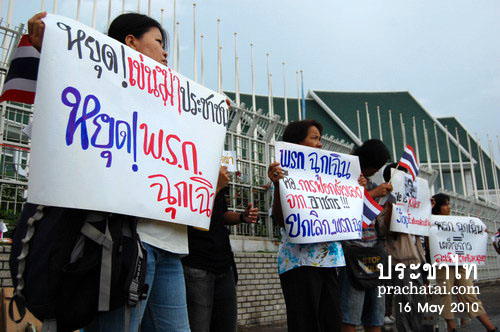
Phanom Balee, from the women labourers group, told us she has come out to demand the government’s dissolution. The government has lost legitimacy from killing innocent citizens.
“I want society to stop seeing the red shirts as terrorists. They’re like the rest of us. They’ve only come to demand their rights. I want people to see them as fellow human beings. We’re all Thai, we have to empathise with each other.” Prachatai asked her whether she was frightened, having come out to demand that the government end the shooting, at a moment when the government was considering declaring a curfew.
“No, I’m not. If I was scared I wouldn’t have come.”

Ekkaraj Sahbu, a peace activist, said he was handing out the “No Kill” stickers to as many people as possible. In his eyes the UN is under obligation to uphold the Universal Declaration on Human Rights.
“Is the UN going to wait until thousands are dead before intervening, like in Sudan or Rwanda? This isn’t to do with politics. It’s the UN’s duty to protect human rights, that’s the organisation’s main obligation. It’s written in the Universal Declaration for Human Rights. The section Responsibility to Protect says that if the national government cannot protect the rights of its citizens, then the duty falls on the international community.
“I would like the UN to act preventatively rather than wait for a major disaster to occur. If this becomes a civil war, it will take no less than 20 years to heal. The extent of the losses will mean that it will take many generations before there can be reconciliation. I beg the UN to fulfil its duty in preventing mass murder. Don’t let Thailand become like Rwanda.
“For all citizens, please come out and show that you own this land. We can stop the violence, please come out and help campaign for peace. We are all brothers and sisters. Don’t feel happy about other people’s losses.”
Ekkaraj also pointed out that it was the government’s duty to create a climate of peace and eliminate all symbols of violence. These include declaring the state of emergency, or letting the military intervene in politics. If the government can put a stop to such violations, then a climate of peace can ensue. And then it can ask the UDD to disband its protests.
“Regarding the government’s demand that the UDD stop demonstrating first, I would say that in order to bring about peace, equality has to be respected on all sides. The current situation is one in which there is a clear imbalance of power between the conflicting sides. The government’s road map proposal is a good thing, but the government isn’t opening up a channel for the other side to fully participate in the negotiation, and to put forward its conditions for mutual consideration. The government is using its power to censor the media, which counts as a grave violation of human rights. Additionally, the state’s refusal to listen to the demands of the opposing side is an example of its reluctance to broaden the basis of political participation. To build up trust, there must be sincerity and there can’t be a climate of suspicion. The state can bring this about.” Ekkaraj concluded.


Many taxis, tuktuks and private cars stopped to take the stickers and letters the campaigners were handing out. Meantime, a vendor selling black grass jelly wheeled up his stall nearby. One of the young campaigners walked over to buy 10 cups of this dessert to quench their friends’ thirst. Prachatai took some more photos before following the group as they moved to the UN’s other gate.

After the 10th cup, the black grass jelly vendor continued pouring his dessert. On his 12thcup now, he shouted out, “who hasn’t got one of these yet? Take one.” Then he handed a cup to our team.


At the entrance of the UN’sconvention centre, this group of students and labourers continued shouting out their fundamental demand: “Abhisit stop killing.”
Translated by May Adadol Ingawanij

Prachatai English is an independent, non-profit news outlet committed to covering underreported issues in Thailand, especially about democratization and human rights, despite pressure from the authorities. Your support will ensure that we stay a professional media source and be able to meet the challenges and deliver in-depth reporting.
• Simple steps to support Prachatai English
1. Bank donation via the "Foundation for Community Educational Media (FCEM)", Krungthai Bank, account number 091-010-4328, Swift Code: KRTHTHBK
2. Or, Transfer money via Paypal, to e-mail address: [email protected], please leave a comment on the transaction as “For Prachatai English”