
It has become clear that the Thailand-Cambodia maritime demarcation dispute will be subject to an international mechanism as Cambodia has recently invoked UN-backed compulsory conciliation in response to Thailand’s unilateral cancellation of a 25-year-old maritime MoU. Here’s all you need to know about the long-standing maritime dispute and the compulsory conciliation process.
The maritime dispute between Thailand and Cambodia has now become only the second invocation in history of the compulsory conciliation mechanism under the UN Convention on the Law of the Sea (UNCLOS).
Last year, Thailand and Cambodia engaged in deadly armed conflict along their 800-kilometre-long border, killing dozens of civilians and military personnel and displacing over ten thousand people.
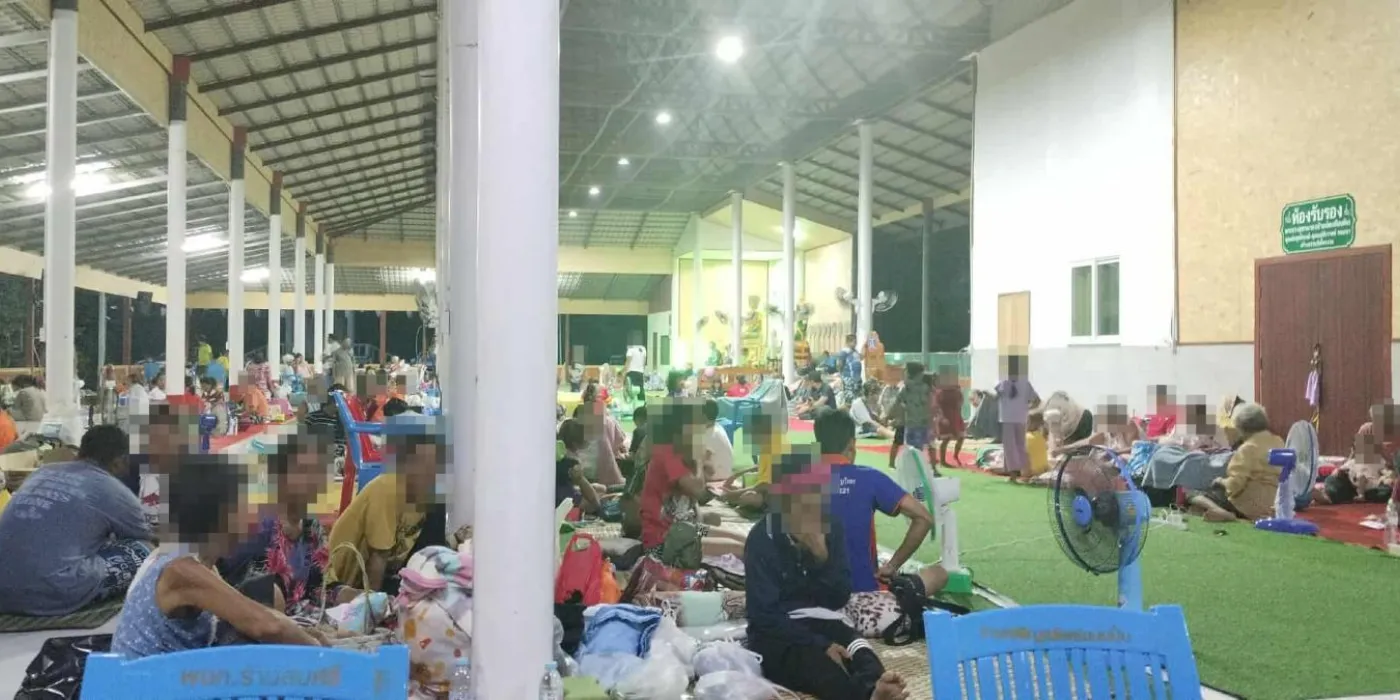
Ten thousand of civilians from both sides had to evacuate due to the deadly clashes last year
(Source: An evacuation center in a province along the border)
While the land border disputes have yet to be resolved and tensions still simmer, another long-standing issue erupted over their maritime border in the Gulf of Thailand.
Earlier this year, the Thai Cabinet under Prime Minister Anutin Charnvirakul resolved to cancel the 2001 Memorandum of Understanding regarding the Area of Overlapping Claims between Thailand and Cambodia, commonly known as MoU44 (B.E. 2544).
Cambodian PM Hun Manet swiftly responded, saying that Cambodia would pursue a resolution under the framework of UNCLOS, particularly the provisions on compulsory conciliation.
“We have delivered a formal notice to Thailand and to the Secretary-General of the United Nations to begin compulsory conciliation proceedings under UNCLOS,” remarked Hun Manet.
What is the Overlapping Claims Area (OCA) between Thailand and Cambodia, and why does it matter now?
Thailand and Cambodia have disputed overlapping claims in the Gulf of Thailand for more than 50 years. The OCA covers around 26,000 square kilometres where the two countries’ Exclusive Economic Zones (EEZ) and continental shelf claims overlap.

Maritime Zones according to UNCLOS
(Source: U.S. Department of State as modified by NOAA)
Under UNCLOS, coastal states possess ‘sovereign rights’ over the exploration and exploitation of natural resources, particularly oil and natural gas, beneath the seabed in the continental shelf.
Significantly, both countries have granted concessions to private companies to exploit the natural resources in the disputed areas. Thailand issued concessions in 1968 while Cambodia followed in 1991.
However, no activities are permitted while the maritime disputes remain unresolved. A preliminary survey suggested that the OCA between Thailand and Cambodia may contain natural gas reserves worth approximately 3.5 trillion baht and crude oil worth around 1.5 trillion baht.
Estimates suggest that existing Thai gas reserves in the Gulf of Thailand may be sufficient for only another five to ten years, raising concerns about the country's long-term energy security.
At a time when geopolitical tensions in the Middle East continue to affect global energy markets and fuel prices, securing new energy sources has become increasingly important. As a result, attention has once again turned to the OCA between Thailand and Cambodia.
Key distinction: Sovereignty VS. Sovereign rights
The international law of the sea evolved from international customary law before being codified in a series of treaties, most notably the 1958 Geneva Conventions on the Law of the Sea and the 1982 United Nations Convention on the Law of the Sea (UNCLOS).
For centuries, the use of the oceans was governed by the principle of the "freedom of the seas," under which states were free to navigate, explore, and exploit resources.
As maritime activities expanded and competition over marine resources intensified, states gradually developed rules to regulate maritime boundaries and jurisdictions.
One of the key concepts established under modern laws of the sea is that of a territorial sea, where a coastal state exercises sovereignty in the same way as it does over its land territory in order to protect national security.
In an EEZ or continental shelf, coastal states possess "sovereign rights”, which cover specific purposes, particularly the exclusive right to explore and exploit natural resources.
A coastal state enjoys exclusive rights to exploit oil, gas, fisheries, and other natural resources within these areas, but it cannot exercise absolute power as it can within its territorial sea.
For this reason, maritime disputes are often driven by economic concerns, especially access to oil, natural gas, and other valuable resources. In some cases, countries have agreed to share benefits while setting aside unresolved disputes.
The stalled progress in Thai-Cambodian maritime negotiations
Following the successful negotiation between Thailand and Malaysia in 1979, which led to a Joint Development Area (JDA) where both countries shared benefits and expenses equally, the JDA was widely regarded as a potential solution to the maritime dispute between Thailand and Cambodia.
However, progress was stalled due to domestic issues in Cambodia. It was not until 2001 that the 2001 MoU was negotiated.
Both countries agreed that 10,000 square kilometres north of latitude 11° North remains to be delimited, while the disputed area south of this was designated as a JDA. Significantly, these arrangements were an ‘indivisible package’. Both countries were bound to negotiate on both areas in parallel.

The Overlapping Claims Area between Thailand and Cambodia
(Source: the 2001MoU)
The Thai side consistently maintained that the two issues should be addressed together due to its concerns over Cambodia’s proposed boundary line, which cuts through the Thai island of Koh Kut. Meanwhile, Cambodia reaffirmed its stance to prioritise the natural resources in the proposed JDA.
The negotiations have stalled once again, given domestic politics in both Thailand and Cambodia.
In 2023, amid concerns over energy security, the government under former PM Srettha Thavisin announced plans to accelerate negotiations with Cambodia. This policy direction continued under the administration of former PM Paetongtarn Shinawatra.
This initiative was abandoned after she was ousted by the Constitutional Court over the leaked call with former Cambodian PM Hun Sen. At the same time, conservative political forces intensified calls for Thailand to scrap the 2001 MoU due to concerns over Cambodia's maritime line, which intersects Thailand’s Koh Kut.
During the election campaign for the 2026 elections, PM Anutin’s Bhumjaithai Party chose to align itself with the nationalist sentiment by pledging that if elected, the party would cancel the 2001 MoU.
After winning the election, Anutin kept his word. On 5 May, the Cabinet agreed to scrap the MoU on the grounds that negotiations had made no progress. The PM asserted that the maritime dispute would be resolved through international mechanisms under UNCLOS.
The cancellation did not affect either country's unilateral maritime claims, which remain unchanged. What disappeared was the 2001 MoU framework that divided the overlapping area into two negotiation tracks.
The Cambodian side has responded by vowing to submit the dispute to the compulsory conciliation process under UNCLOS. Cambodia has now invoked this and appointed its two conciliators: Danish diplomat Peter Taksøe-Jensen and French academic Jean-Marc Thouvenin.
Koh Kut dispute
Thailand is likely to be in a strong legal position regarding Cambodia’s claimed maritime boundary line through Koh Kut.

The 1907 Siam-Franco Treaty, where Koh Kut is mentioned.
"The boundary between Siam and French Indo-China starts from the coast opposite the highest peak of Koh Kut..."
Cambodia bases its claim on, the highest point of Koh Kut, which was used as an indicator in the 1907 Franco-Siamese Treaty, but Thailand argues that this was to establish the land boundary, not the maritime boundary. The Treaty also explicitly recognises Koh Kut as Thai territory.
Under UNCLOS, an inhabited island is entitled to its own territorial sea, EEZ and continental shelf. As a result, Thailand argues that the boundary line should be redrawn in a straight southwestern direction away from the island.
The legal status of Koh Kut could be one of the key factors to be considered during the dispute-resolution process.
Phattharaphong Saengkrai of Thammasat University’s Faculty of Law observes that Cambodia has long been aware that its claimed maritime boundary line near Koh Kut may be difficult to reconcile with the principles of maritime delimitation under UNCLOS.
This could suggest that Cambodia is prepared to negotiate an adjustment to its maritime claim.
“Cambodia’s rather swift decision to move to conciliation, while it is aware that its claimed boundary line through Koh Kut may be difficult to defend under the law, may be something that we can read as a signal that Cambodia may be willing to abandon its claimed line,” said Dr Phattharaphong.
Compulsory conciliation: third party involved
Since UNCLOS came into force in 1994, compulsory conciliation has been used only once, in the Australia–Timor Leste case, making this only the second case in the history of the international law of the sea.
Under UNCLOS, compulsory conciliation does not require the consent of all parties involved. Any party wishing to invoke it may submit a written notification to the other party. Failure of the other party to respond is no bar to the proceedings.
According to Article 298, a state is allowed to opt out of a certain dispute resolution mechanism under UNCLOS, but is bound to accept Section 2 in Annex V, which deals with compulsory conciliation.
Thailand has declared that it does not accept arbitration through the courts regarding maritime boundary delimitation disputes. Even though Cambodia cannot take the case to the international courts, as occurred in the dispute over the Preah Vihear Temple, compulsory conciliation is an alternative approach that Cambodia can use.
The mechanism employs five Conciliators. Each party is required to appoint two Conciliators. These four then select a fifth to chair the Conciliation Commission.
After Cambodia formally notified Thailand regarding its appointed Conciliators, Thailand has 21 days to appoint its own.
The Commission will hear the parties, examine their claims and objections, and make proposals to the parties with a view to reaching an amicable settlement.
According to UNCLOS’s Annex V, once the Commission is formed, the Conciliators have to issue a report within 12 months, recording any agreements reached or even failures to agree.
The Commission’s report may also include recommendations. The involved parties have to enter into a bilateral agreement to resolve the disputes based on the recommendations in the report. Unlike the verdicts of a court or arbitration, the Commission’s recommendations do not legally bind the parties.
“The main purpose of the conciliation is to facilitate both parties’ amicable settlement of their disputes, not for the Commission to solve it for them,” Abdul Gadire Koroma, a former judge of the International Court of Justice, said in 2024.
If Thailand and Cambodia remain unable to reach a mutual agreement, the next step would involve the international courts, provided that both parties have ‘mutual consent’ to bring the case to the courts.
Many observers believed that compulsory conciliation offers the best opportunity for both sides to negotiate, rebuild trust, and make progress on issues that have been stalled for decades.
“Equitable solution”: cornerstone of the International Law of the Sea
“Thailand first. There will be nothing for Thailand to lose.” This was PM Anutin’s remark following the Cabinet’s decision to cancel MoU44.
However, achieving an ‘equitable solution’ is the foundation for resolving OCAs under the framework of UNCLOS. This does not necessarily mean an equal division of the disputed area.
“Unlike cases of disputed sovereignty over land territory where there is often ‘a winner’ or ‘a loser’ in the sense that the territory in question is awarded to one side or the other, maritime delimitation disputes rarely resulted in an ‘all or nothing’ decision,” said Rodman Bundy, a preeminent figure in international law, in 2006
Maritime delimitation under UNCLOS considers a range of factors, including geography, coastline, historical circumstances, economic considerations, and, in some cases, environmental concerns.
Several international law experts argued that the government and the Foreign Ministry should provide the general public with an understanding of the possible scenarios over the next few years. The maritime dispute may differ fundamentally from the ongoing land disputes, but the outcome could have significant implications for overall bilateral relations.
More importantly, given the volatility of current Thai-Cambodian relations, many observers argue that the ultimate success of the resolution process depends on the political will of both governments.

Prachatai English is an independent, non-profit news outlet committed to covering underreported issues in Thailand, especially about democratization and human rights, despite pressure from the authorities. Your support will ensure that we stay a professional media source and be able to meet the challenges and deliver in-depth reporting.
• Simple steps to support Prachatai English
1. Bank donation via the "Foundation for Community Educational Media (FCEM)", Krungthai Bank, account number 091-010-4328, Swift Code: KRTHTHBK
2. Or, Transfer money via Paypal, to e-mail address: [email protected], please leave a comment on the transaction as “For Prachatai English”