
These days, anyone heading down Ratchadamnoen Klang Road in Bangkok’s old town can’t help but notice the construction of the MRT Purple and Orange Lines, which sometimes slows traffic to a crawl.
A closer look reveals another transformation that is quietly underway: the façades of distinctive buildings along the road are being remodelled. Among them are the Rattanakosin Exhibition Hall, the Deves Insurance building, and the Ratchadamnoen Contemporary Art Centre.
Built by the People’s Party, the revolutionary founders of Thai democracy, these structures are part of the 21 Art Deco–style structures - initially called modern buildings - situated along Ratchadamnoen Klang Road.Their design was not only meant to convey luxury and technological progress but also the revolutionary ideals that accompanied the birth of Thailand’s constitutional monarchy.

An overview of Ratchadamnoen Klang Road from July 2025. Photo by Kotcharak Kaewsurach.
Click arrows on the side to see more photos.
These buildings are not the only ones being renovated. So are a number of other structures around the Democracy Monument, a historic landmark and a rallying point for political protests. The list includes a McDonald’s branch and an old Thai restaurant, Methavalai Sorndaeng.
In an interview with Prachatai, Prof Dr Chatri Prakitnonthakan, an architectural historian at Silpakorn University, explained that the renovation work is part of a broader effort to eradicate the People’s Party’s political legacy.
Building façades are being redone in the neo-classical style that was popular in the absolutist period during the reigns of Kings Rama V and VI. The style - which was popular in Europe and the United States in the 18th and 19th centuries - revives elements of Greek and Roman design, including columns, geometric pediments, and restrained ornamentation.
Professor Chatri is critical of the project and its developers. In addition to showing little respect for Ratchadamnoen Klang history, he feels that the renovation does little to showcase Thai art and promote tourism. He also worries that the makeover might eventually threaten Democracy Monument, the symbolic heart of the area.
Crown Property Bureau policy
According to Professor Chatri, plans to remodel the façades of roadside buildings have circulated since 2020. An architectural rendering of a redesigned Rattanakosin Exhibition Hall was released, but he and many others doubted the project would proceed.
Then in 2023, the Exhibition Hall was fenced off and the next year, its new façade was unveiled. Shortly thereafter, renovations began on the Deves Insurance building and the Ratchadamnoen Contemporary Art Centre

The exterior of the Deves Insurance Public Company Limited building is visible, but a zinc fence is still in place and workers are still working around the building. Photo by Kotcharak Kaewsurach
Upon investigation, Chatri discovered a draft Terms of Reference (TOR) on the centre’s website, detailing a contract for fiscal year 2024, part of the Crown Property Bureau’s (now the Privy Purse) policy to renovate and rename 17 buildings.
It described “a collaboration between the Office of Contemporary Art and Culture and the Crown Property Bureau, using blueprints, decorative plasterwork designs, and lighting installations, to restore buildings in the neoclassical style of King Rama VI’s early period.” While the land along Ratchadamnoen Klang is owned by the Crown Property Bureau, the renovation of each building is being commissioned by individual tenants.
The Battle for Public Memory Spaces

The exterior of the Ratchadamnoen Contemporary Art Centre building remains completely covered with cloth.
Photo by Kotcharak Kaewsurach
The official justification given for the Ratchadamnoen Contemporary Art Centre renovation is “to preserve historical buildings”, “preserve Thai art”, and “to promote tourism.” As noted above, however, Professor Chatri remains sceptical.
King Chulalongkorn commissioned the construction of Ratchadamnoen Nok, Ratchadamnoen Nai and Ratchadamnoen Klang Roads, and the construction of neo-classical buildings around the city. However, Chatri said that no neo-classical building has ever been built along Ratchadamnoen Klang Road. The earliest structures that stood along the roadside were the Art Deco buildings built in the 1930's during the People's Party government.
As for preserving Thai art, the professor notes that neo-classical architecture and Art Deco are of Western origin. With respect to promoting tourism, he wonders why foreigners would want admire fake neo-classical façades when they could go and see authentic ones like the Ananta Samakhom Throne Hall, the Custom House, and the buildings housing the Ministry of Foreign Affairs, the Ministry of Interior, and the Ministry of Defense.
Chatri suspects that the real reason for the renovation project is to reclaim public memory spaces associated with the group that toppled the absolute monarchy and established the country’s first constitutional government - the People’s Party.

Sign for the renovation of the Ratchadamnoen Contemporary Art Gallery, a 58-million-baht project by the Office of Contemporary Art and Culture, scheduled from September 12, 2024, to September 6, 2025. The end reads: “Conservation carried out with your tax money.”
The People’s Party’s Art Deco
Art Deco architecture does not signify opposition to absolutism in other countries. That interpretation is unique to Thailand.
The style became popular in Thailand before the 1932 revolution. Examples can be found in Chinatown and parts of the Sala Chalermkrung Royal Theatre, a project initiated by King Rama VII. While not pure Art Deco, these buildings represent early modern architecture closely related to the Art Deco style.
After the People’s Party came to power, its urban planning and use of Art Deco architecture along Ratchadamnoen Klang, and at sites in Lopburi, Ayutthaya, and Bangkok’s Bang Khen district, were political statements, symbolising a rejection of the earlier absolutist regime style.
The People’s Party used the original meanings of Art Deco, which broke from neo-classical and Art Nouveau styles, and incorporated new motifs and political symbols signifying the Party’s six core principles.
The Party’s “new Thai motifs” embraced geometric, minimalist forms. With sleek lines and upward thrusts echoing industrial progress, they deliberately rejected the traditional Thai decorative patterns of earlier periods.

Art Deco cantilever support at Wat Phra Phutthabat, Saraburi. The blueprint from the book Buddhist Architecture Part I. The right shows the traditional style, while the left is reinforced concrete in Art Deco form — smoother, geometric, and in the style of the People’s Party. From the seminar “People’s Party and Wat Phra Phutthabat” in 2023. Source: Saraburi People’s Youtube Channel.
A “Constitutional Tray” symbol was incorporated into public landmarks like Ratchadamnoen Road’s Democracy Monument, and public memorial commemorating the suppression of a royalist counter-rebellion in October of 1933. The Party’s six principles were also symbolically expressed in design details: the six gates and swords at the Democracy Monument, and the six columns on the former the Supreme Court building’s façade.
“Since the People's Party used these symbols repeatedly … they became associated with it,” said Chatri.

The Democracy Monument features a constitutional tray, six swords, and six doors to represent the six principles of the People's Party.
Photo by Kotcharak Kaewsurach
In contrast, during the wave of European-inspired reforms in the mid-1890s, King Rama V commissioned buildings in various styles, neoclassical, neo-renaissance, and Jugendstil. As neoclassicism was the dominant style, it became publicly linked to the absolute monarchy.
This, Chatri believes, is why contemporary royalists are bent on replacing the architecture of the People’s Party period with neoclassical forms. He sees it as “a battle of opposing ideologies.”
From passivity to hatred
After the People’s Party fell from power in 1947, their architectural legacy remained in place, but preservation was neglected.
In the late 1980s, MR Kukrit Pramoj, a member of the royal clan and former conservative prime minister, took steps to demolish some of the buildings, but succeeded with only one: the Sala Chalerm Thai Theatre.
Writing in Siam Rath newspaper in 1989, he complained that:
“...the Sala Chalerm Thai Theatre … completely obscures the view of … the beautiful Ratchanatda Temple … one only sees … the theatre and its modern architecture ."
He loathed People’s Party period architecture but it was not until after the 2006 military coup that conservatives moved to tear it down. Following a resurgence of pro-democracy sentiment, culminating in major protests in early 2010s and 2020s, they launched a royalist reclamation of public memory space in Bangkok.

Public announcement inviting people to clean the Constitution Defense Monument and commemorate the People’s Party on National Day 24 June 2016.

Red Shirt protests at the Constitution Defense Monument on 14 October 2012, the same date the People’s Party defeated the Boworadet Rebellion at Thung Bang Khen in 1933.
According to Chatri, the aim was to remove buildings and symbols that challenged conservative, royalist ideology.
The Supreme Court building, which featured a People’s Party design, was demolished in 2012–2013 and rebuilt in an applied-Thai style. After the 2014 coup, the erasure intensified: in 2017, a plaque commemorating the 1932 uprising was mysteriously replaced with another admonishing people to respect traditional authority and the following year, a monument honouring the 1933 suppression of a royalist counter-rebellion disappeared.
Memorials honouring People’s Party leaders were also removed. In 2020, Phibun Songkhram military base in Lopburi was renamed after King Bhumibol. So was a base named for Phraya Phahonyothin, leader of the People’s Party coup group. The same year, Phibun Songkhram’s former residence in Chiang Rai was rechristened as historical learning center and his name was subsequently removed from a bridge that was renamed after a commander in the 1933 royalist counter-rebellion.
Some structured have seemingly been spared. The Bangrak Central Post Office, which shares features with many of the renovated or demolished buildings, remains untouched, having been repurposed as a hub for creative design. Presumably, it has been stripped of its political significance. The Victory Monument, built during the tenure of Phibun, also remains untouched. From the time of its construction until now, it has been a place of military celebration, less a symbol of the People's Party and more a monument to military pride. Recently, conservatives even rallied there to demand the removal of Prime Minister Paethongtarn Shinawatra.
Deleting doesn’t make us forget
When the Sala Chalerm Thai Theatre was demolished, there was no social media. Most stories were passed down by word of mouth, and people forgot them within a few days. Today, there are many more ways to preserve memories, from digital archives to printed models, from gachapon figures to pins and keychains.
Chatri thinks that the erasures and demolition still accomplish their purpose, however. “In the past, people could go to stand around the People's Party plaque, reading the declaration together in front of the Anantasamakhom Throne Hall … more powerful than wearing a People’s Party plaque watch or carrying a People’s Party plaque keychain.”
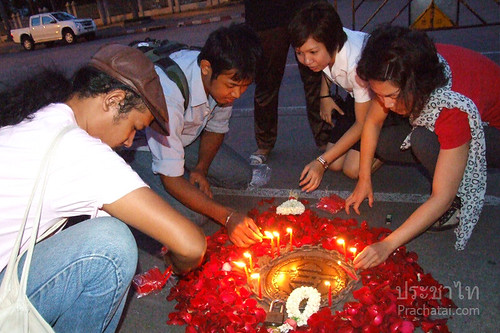
Citizens and activists commemorate the 78th anniversary of the People’s Party revolution at the People’s Party plaque, 24 June 2010. (Prachatai/File photo)
“When the Supreme Court building was demolished, I was really upset,” Chatri said. He feels that political conflicts should not result in demolishing historical buildings. “But now I've come to terms with it and think that the right thing to do in this situation is to provide knowledge and historical facts .. creating a website as a database.”
Motivated by growing public interest and after meeting Søren Ivarsson, a Danish lecturer who showed him how other countries were using websites to preserve historical artifacts, Chatri launched a website called Revolutionary Objects with the goal of collecting 2,475 People’s Party–related items. The number corresponds to the B.E. year of the revolution.
“It's going to be very challenging because it requires a budget, the help of many people, and a lot of energy. I think it will proceed slowly. But at least, if there is this website as a dream that has been created, even if it is left unfinished, even if we can't complete it today, one day someone might see its future utility, take it over and do it.”
“In my view, it's a lifelong project... Whenever we have free time, we’ll add more material. If there are new generations or academics who are interested, they can add more too. If there are people doing research on related topics, they can too.”
Future of Democracy Monument
Demolitions are currently less frequent than in 2019–2020, but concerns remain, especially with buildings along Ratchadamnoen Klang Road. Chatri warned that a renewed political crisis, including a possible coup opposed by people citing People’s Party ideals, could prompt conservatives to eliminate all reminder of the revolutionary period.
He also wonders about the future of the Democracy Monument, a complicated case. Built by the People’s Party, Its meanings have also been shaped by the mass protests of October 1973 and May 1992 as well as pro-coup movements such as the People's Democratic Reform Committee (PDRC) and People's Alliance for Democracy (PAD) or the Yellow Shirts, who also claim to support democracy.
“The monument carries overlapping meanings, setting it apart from the People’s Party plaque and the Constitution Defense Monument at Lak Si Circle. Those had a single meaning - opposition to the absolute monarchy.”

Red Shirt rally at Democracy Monument on 13 December 2010.
PDRC rally on 22 December 2013. Courtesy from Matichon Online
Chatri thinks there is an 80% chance that it will be demolished or remodelled in the neoclassical style. After the conservatives finish remodelling the Art Deco buildings along Ratchadamnoen Klang Road, they will use the precedents as an excuse to press on.
“As for the 20%, I still have a little hope in the conservative group. A lot of them lived through the protests of 14 October 1973 and May 1992 … and have strong connection to Democracy Monument as their own site of struggle. But many in this group have turned against democracy, supporting coups, and becoming more conservative."
"I just hope that some of them still have some sense left. Democracy Monument has a more complex meaning, and it has a higher level of value. It has been through political struggles, bearing witness to numerous political changes in Thailand. It holds immense historical value."

Democracy Monument seen from the MRT construction site on the central reservation of Ratchadamnoen Klang Road.
Photo by Kotcharak Kaewsurach.

Prachatai English is an independent, non-profit news outlet committed to covering underreported issues in Thailand, especially about democratization and human rights, despite pressure from the authorities. Your support will ensure that we stay a professional media source and be able to meet the challenges and deliver in-depth reporting.
• Simple steps to support Prachatai English
1. Bank donation via the "Foundation for Community Educational Media (FCEM)", Krungthai Bank, account number 091-010-4328, Swift Code: KRTHTHBK
2. Or, Transfer money via Paypal, to e-mail address: [email protected], please leave a comment on the transaction as “For Prachatai English”