
A court has dismissed charges filed against a man for the death of Warit Somnoi, a 15-year-old protester killed after being shot during a protest near Din Daeng Police Station on 16 August 2021, citing unclear evidence.
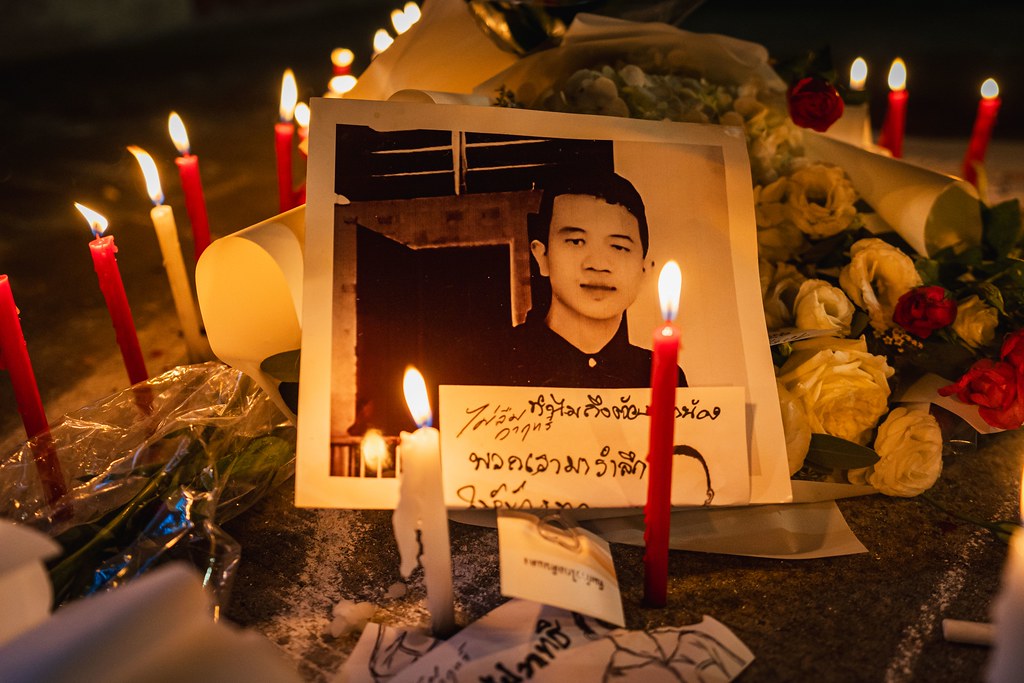
Warit's photo among candles and flowers at the vigil on the second anniversary of his death. (Photo by Ginger Cat)
Apirak Nantaseri, a lawyer from the Human Rights Lawyers Alliance, said that the Criminal Court on 25 September dismissed charges against Chutipong Tidkratok, 30, who was accused of shooting Warit and charged with premeditated murder, among other charges. He was also charged with attempted murder and assault for the attack on three teenagers in the Din Daeng area, around 10 minutes before Warit was shot.
Chutipong was arrested on 30 September 2021, nearly two months after Warit was shot, and indicted in July 2022. It has been reported that an arrest warrant was issued for another suspect, but the police have been unable to arrest them.
The Criminal Court dismissed the charges filed against Chutipong for Warit’s shooting on the grounds that the evidence is not clear enough and so the Court gave him the benefit of the doubt.
Warit was shot along with another 14-year-old protester with live rounds near Din Daeng Police Station after a protest on 16 August 2021. The 14-year-old was reportedly shot while riding a motorcycle past the station and sustained minor injuries to his shoulder. Warit was shot in the neck. The bullet fractured his cervical vertebrae and lodged in his brain. He died on 28 October 2021 after spending two months in a coma at Rajavithi Hospital’s intensive care unit.
Apirak noted that, although the Court believes that the bullet used to shoot Warit came from the same gun used by Chutipong’s friends, the evidence presented to the Court could not prove that he was involved in shooting Warit. Because the charges against him were dismissed, Chutipong will also not be liable for damages in a civil lawsuit filed by Warit’s family.
Apirak also said that testimony given by prosecution witnesses in court does not match the testimony they gave to the police. An eyewitness previously told the police that he saw a person shoot at Warit, but in court, the witness testified that he was standing far away from the scene of the shooting and only heard of the incident from an acquaintance. The Court ruled to go by the witness’ courtroom testimony, not their police testimony, because it was in line with footage obtained from a CCTV camera in the area.
Apirak said that the Court gave its best ruling from evidence presented by the public prosecutor and Warit’s mother. The problem could lie with the police case file, he said.
The police investigation into Warit’s case faced several delays. Apirak said that there was very little progress until Warit’s family filed a complaint with the House Committee on Political Development, Mass Communications, and Public Participation. He also said that the Din Daeng police may have been negligent during the investigation, noting that, after the case was forwarded to the public prosecutor on 20 December 2021, the public prosecutor had to make 7 requests for additional information from the Din Daeng police before Chutipong could be indicted.
The police also could not obtain some evidence during the investigation. Apirak said that the main evidence used in the case, footage from a CCTV camera owned by the Bangkok Metropolitan Authority (BMA), was obtained by the House Committee on Political Development, Mass Communications, and Public Participation. However, the lawyers never received video evidence from the police, which means that there is no eyewitness that could identify the culprit. He noted that, since the bullet was fired from Din Daeng Police Station, getting to see footage from the police station CCTV camera could help determine the bullet trajectory and the identity of the shooter.
Apirak said that the police did not coordinate with Warit’s family or their lawyers. Meanwhile, no prosecution witness came to testify in court and or could be contacted. The lawyers learned later that the police had decided to prosecute some witnesses for past offenses, while others who testified during the investigation were threatened by officers and were too afraid to come to court.
Although the family’s lawyers asked the police to summon witnesses to court, the police were not cooperative, claiming that the witnesses could not be contacted, and that no one lives at their registered addresses. The only prosecution witnesses who came to court were police officers. The family’s lawyers had to seek out civilian witnesses themselves.
The family and their lawyers are now discussing whether to file an appeal. Apirak said that if both the Appeal Court and the Supreme Court uphold the Criminal Court’s ruling, the family could look for new evidence and file charges against the perpetrators within 20 years. However, Apirak believes that it will be a difficult process since it would be almost impossible to collect evidence or identify the perpetrators without the use of government resources. It would also be damaging to the family’s mental health.

Prachatai English is an independent, non-profit news outlet committed to covering underreported issues in Thailand, especially about democratization and human rights, despite pressure from the authorities. Your support will ensure that we stay a professional media source and be able to meet the challenges and deliver in-depth reporting.
• Simple steps to support Prachatai English
1. Bank donation via the "Foundation for Community Educational Media (FCEM)", Krungthai Bank, account number 091-010-4328, Swift Code: KRTHTHBK
2. Or, Transfer money via Paypal, to e-mail address: [email protected], please leave a comment on the transaction as “For Prachatai English”